


Plant context
The robotic cell is made up of three heterogeneous subsystems that must operate in coordination:
- Fanuc R-2000iC robot — handling and machine tending
- Modula vertical storage system — material storage and management, integrated via the Link 2.5 protocol
- Two DMG CNC machining center — mechanical machining
The main challenge in this type of configuration is not the handling itself, but maintaining consistency between the physical state (where the part actually is) and the logical state (what the software believes). Any misalignment between the two leads to downtime, rework, or loss of batch traceability.
The project was developed in collaboration with Mirai Tech, which contributed know-how on CNC dynamics; noname.solutions developed the entire software supervision layer: communication protocols, mission orchestration, database, logging, and operator interfaces.
Supervisor architecture
The supervisor was developed with a client–server architecture and an event-driven orchestrator, with persistence on SQL Server. Communication with the subsystems takes place over TCP/IP for the robot and CNC machines, and via the Link 2.5 protocol for the Modula vertical storage system. There are no third-party middleware layers between the supervisor and the devices: every integration is implemented directly by noname.solutions, including the SNPX protocol for managing Fanuc registers and missions
Implemented capabilities (end-to-end cell operation)
- Job lifecycle management: pick, store, and configurable production sequences up to multiple phases/stages
- Physical/logical control: continuous consistency checks between the real position and the logical state stored in the database
- Automatic recovery & exception handling: in case of scrap, errors, or flow inconsistencies, a protected recovery procedure automatically returns material to Modula while preserving traceability
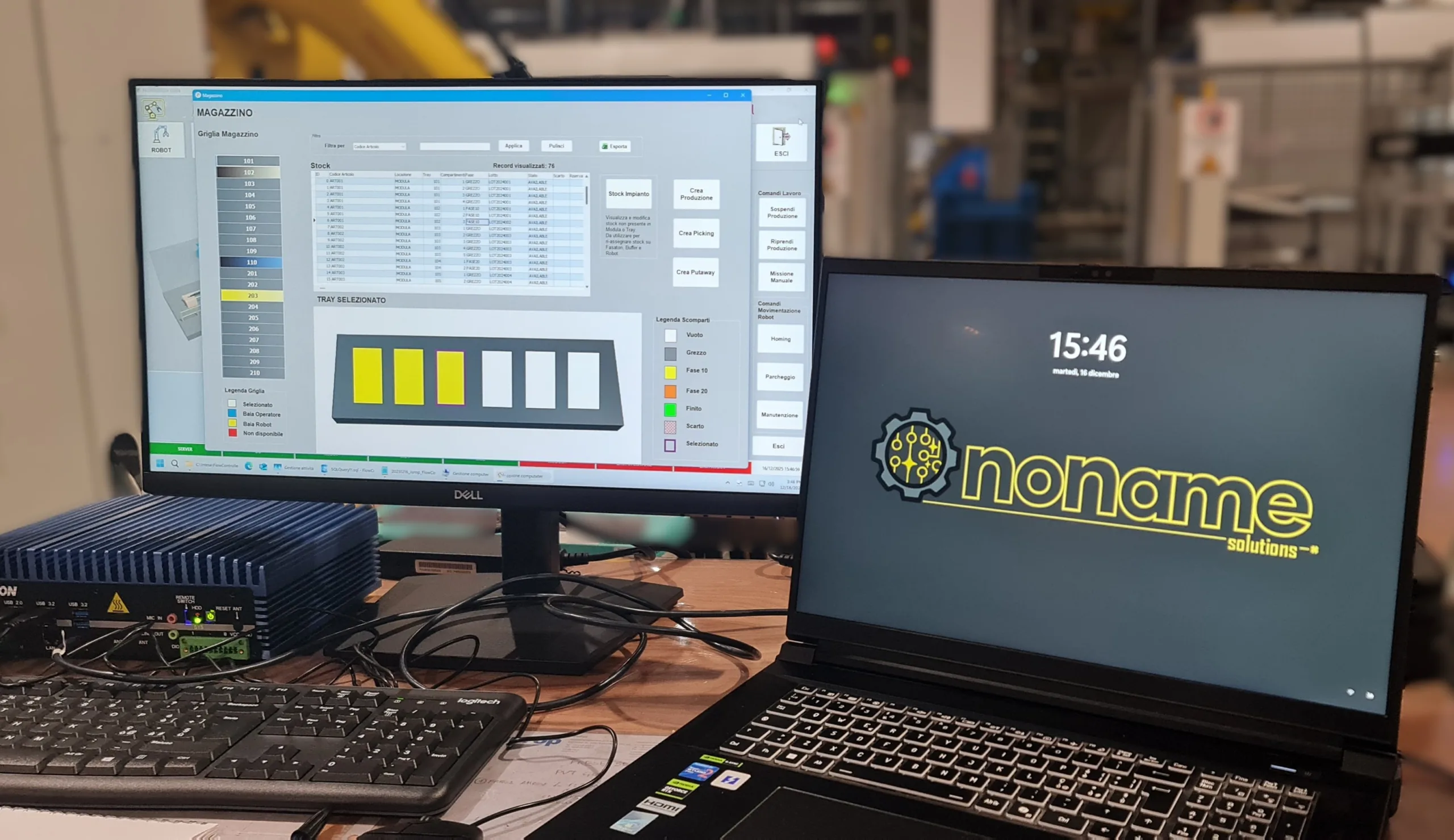
- Real-time HMI/synoptic view: machine statuses, active alarms, and current positions
- Tooling, part numbers/items, and machining phase management
- Operator workflows for picking, storage, and inventory: guided steps, reduced errors, immediate visibility of missions and material availability
- Robot homing, parking, and maintenance logic
- Database backup & governance: database management to ensure recoverability, consistency, and operational continuity
- Multi-category logging with configurable retention and automatic backup
Modula-specific warehouse management: tray reservation, operator/robot bay management, mapping control, and automated inventory
Technologies used
- Embarcadero RAD Studio
- MS SQL Server Express 2025
Error handling and recovery
In real-world production, unexpected events are normal: scrap, communication timeouts, positioning errors, and cycle interruptions due to operator access. The supervisor handles these cases through a structured recovery procedure: the material is returned to the warehouse with correct identification, the logical state is reconciled with the physical state, and the event is recorded in the logs without losing the context of the interrupted job.
The design goal was that no cycle interruption should require manual intervention to reconstruct the cell state. The supervisor must be able to autonomously determine the current situation and propose or execute the recovery actions.
Production performance and results
The supervisor was integrated from the very beginning of the commissioning phase, supporting the cell’s gradual ramp-up. Refinements were deployed while the system was in operation through targeted, non-invasive interventions, avoiding prolonged downtime and preserving operational continuity.
Measurable results to date:
- Downtime caused by mismatches between robot sensor states and software states: eliminated
- Storage errors: reduced thanks to real-time physical/logical control
- Traceability available at all levels: batches, jobs, lots, items/parts, complete history
- Operator training time: reduced thanks to the real-time synoptic view, which makes the cell status easy to understand without specific knowledge of the underlying system
Critical issues during the first quarter of operation
Parts handled simultaneously at steady-state operation
Configurable workflow stages
Operator training required
Empowered by:

